Showing posts with label arts and crafts. Show all posts

June 09, 2013

Anargiros Paschalis: interpreting loneliness

It's really not easy to talk about Anargiros Paschalis' work since words are not always enough to describe some certain feelings running out of certain situations.

Anargiros' work is about these times in life that no matter how long and rough the way may be, we've got to walk it all alone to the end in order to find ourselves and save what's left.

"My work is about spirituality. It's about self-knowledge" explains Anargiros.

"All people have worries, little jealousies, insecurities...that's what makes human world so sweet and tender".

"We all have fears and personal demons. I'm inspired of people that dare to face them. It's a hard procedure and it takes lots of courage to do that no matter if it's about getting rid of a bad addiction or feeling".

"I believe that people who've been through it finally succeed to get along with themselves".

"These people have taken a step forward: they swing in the air".

" I try to interpret iconically the meanings of loneliness and swinging in the air, the relation between the sky and earth..." he goes on.

The element of loneliness is also dominating in Anargiros Paschalis' work.

The funambulists, his personal trademark, always walk alone in a dark, unfriendly universe. It's a personal universe in which loneliness is a state between imbalance and balance on the way to self-knowledge.

Anargiros ' latest exhibition at the Athens Art Gallery, in Kolonaki, ended recently after being extended with four weeks by public demand.

His work has definitely caught the attention of art lovers and has already earned the respect of a fanatic audience that would never miss the chance to step into Anargiros Paschalis' universe.

paschalis.atspace.com

May 23, 2013

Anna Wich: with love from Germany

The truth is that I had never heard of Anna Wich before last evening but thanks to my friend Esther I got to know this great photographer's work that was recently exhibited at the Goethe Institute.

Her images are clear and totally honest with intensive lines and forms, illustrating the unseen -to the common eye - magic of Athens daily life.

Anna Wich visited Greece in 1975, a little after the fall of the military junta and before the beginning of the abrupt modernization that followed. It's a short mid-time that Greece tries to balance between the old and the new.

As everyone was leaving the past behind, looking to the future , Anna Wich turned her lens onto this time being focusing on neglected faces, places, spaces that probably no one else cared about.

" Artists should not be after the success" she used say. "Photography has to set reality and people free".

Anna Wich was German. She was born in 1949 and grew up in Frankfurt. She then moved to Paris and finally chose to live in Athens where she worked as a photographer for both magazines and the greek film industry and also as a monteur.

Anna Wich died from cancer in 1998.

May 15, 2013

The Runner

When "The Runner" first stood in Athens, in 1994, lots of people were shocked. That "thing" - as many used to call the sculpture of Costas Varotsos- had nothing to do with what was already known and Greeks were not that open to new ideas yet.

In fact "The Runner" is the first work of contemporary art that was ever introduced in town and it was commissioned by the City of Athens. It is made of glass stack on iron and by that time it was the tallest sculpture made of glass in the whole world. Actually, it is 12 meters tall and it demonstrates the relation between man and the contemporary city.

Earlier I passed in front of it. Though I've always liked it, lately I appreciate it even more. To me, it represents both the speed with which everything changes and moves on and the passage from one time to another as well.

By the time it was built, Greece was so different. It is indicative that, according to a research run by the "Observatory for the Protection of Human Rights Defenders", in 1997, the 81% of Athens' citizens believed that without the Greek Orthodox Church, Greeks could not possibly have any future as a nation.

The transition of the traditional, introverted Greek society to an open, multi-culti one, happened rapidly. In a research of 2006, the 65% of Greeks advocated the total and official separation of State and Church. As globalization extended, the whole Greek way of thinking and living changed.

Now days, Greece is going through one more phase of transition. Only this time, it's more difficult and less glamorous. No one knows where we are heading to. "The Runner" though is still there constantly reminding that times not only change but can change for better too. Today, he's considered as one of the most important pieces of modern art in Greece.

May 02, 2013

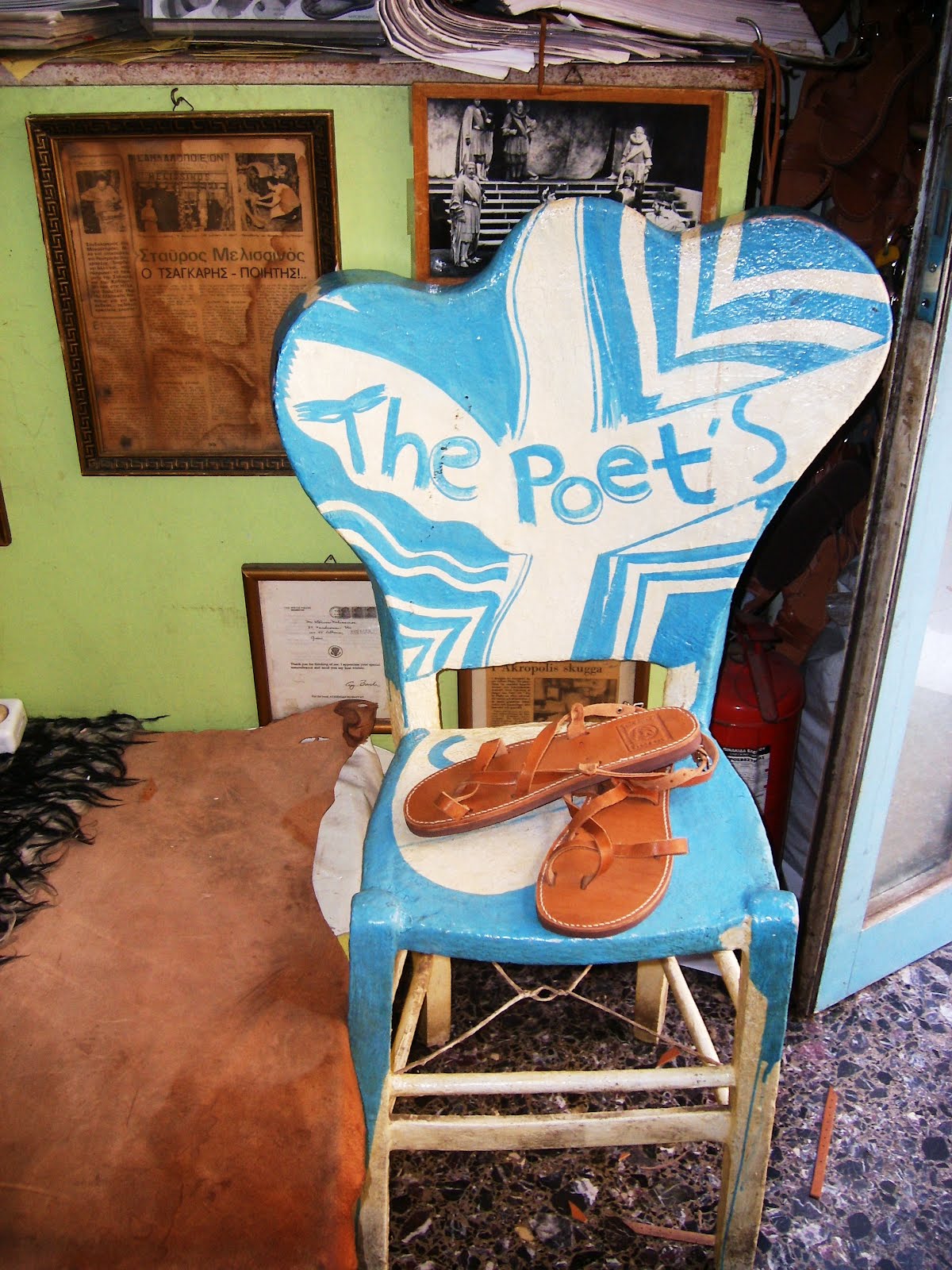
The Poet- Sandalmaker

Do you know what's the Greek thing that connects Prince Charles with Sarah- Jessica Parker and Maria Callas with John Lennon and Jeremy Irons?

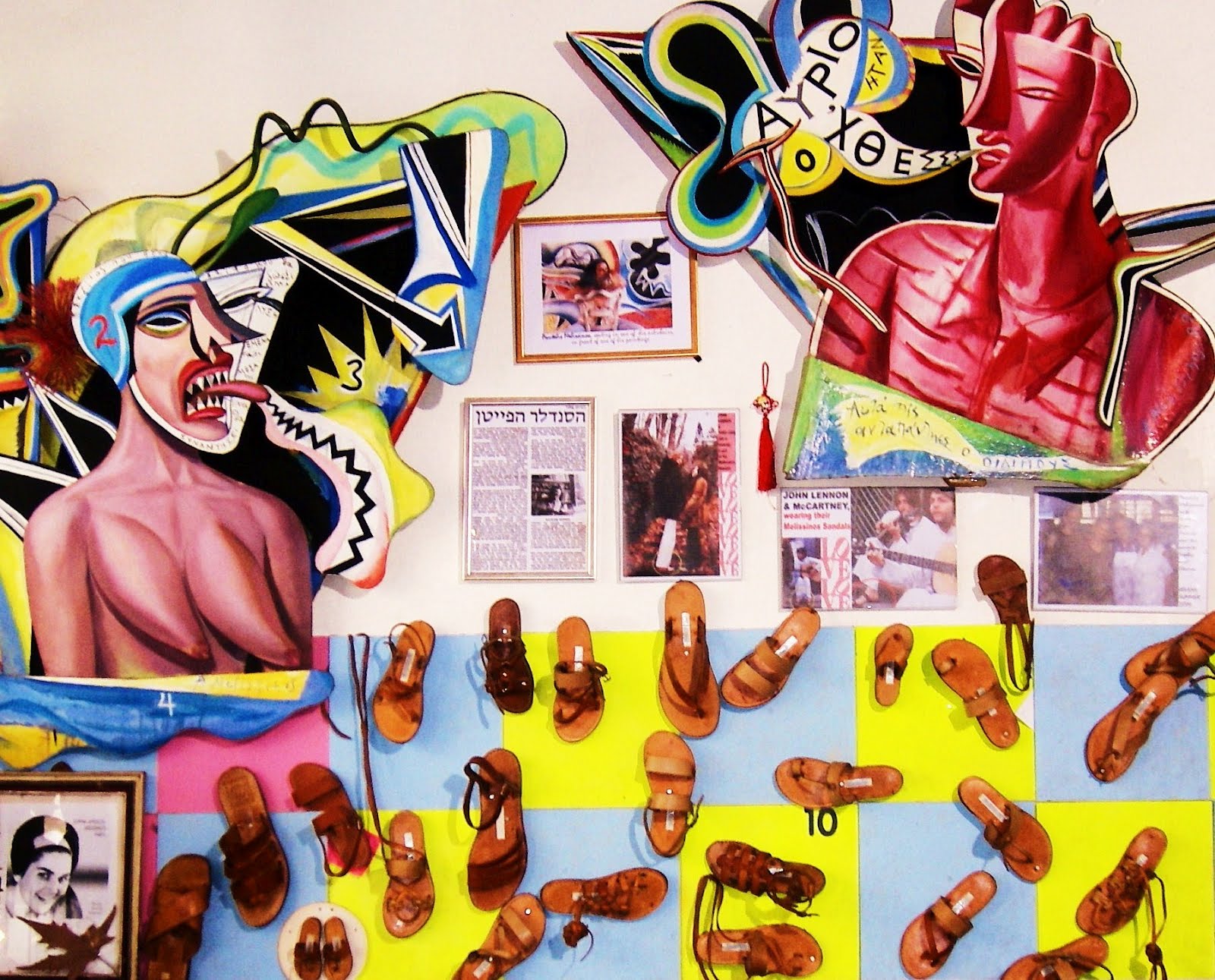
The window and walls of the "Poet-Sandalmaker" shop are tiled with autographed headshots of all famous people who visited the store since it opened in early 1950s.

In fact, the Poet-Sandalmaker, as everyone called Stavros Melissinos, was the first to introduce ancient Greek sandals as everyday footwear. By then sandals were only used in the theater and cinema.

Six decades later Stavros Melissinos' son continues the family tradition. His artistic touch is everywhere.

Pantelis Melissinos lived and worked in New York after he got a BA and MA degree in Fine Arts from Parson's. "I couldn't bear the thought though that someday all that would be gone along with my father and I decided to come back" he says as he's comfortably seated in an armchair he made recently.

"Everything's full of memories here. I grew up in my father's workshop.

I was a little boy when the Beatles came for the first time. Girls were screaming and pushing on the window" he remembers.

" These are Jackie Onassis' favorite sandals. My father named them after her ".

Sandals hang all over the place like bunches of grapes. They are handmade of high quality leather.

Pantelis learned the art of sandalmaking by the side of his father. Today he is one of the last sandalmakers in Greece.

"Things have changed dramatically during the last couple of years. Though it is more difficult now, I haven't regretted coming back. I believe crisis can be an opportunity for Greeks. We may become better people" he says.

He's looks so calm. In fact he's the first businessman I've met lately that does not complain about the situation. " I'm happy with what I do and to me that's enough " he explains.

As I was listening to him I wished I thought like that but that didn't last enough. While scratching upon the dozens of different sandal styles I got face to face with my real me. I just couldn't choose between the sandals below. The ones above are named by the ancient Greek philosopher Platon.

"The Poet-Sandalmaker" is located in Psyri which is right next to Monastiraki and it's definitely the best place in Athens to get a pair of handmade sandals. Prices start from 13 euros and go up to 30 depending on the style and size. You can check out more on his website: www.melissinos-art.com

March 27, 2013

At the Benaki Museum: "9 Lumen", Yiannis Adamakos

When most things seem to go wrong, art is the only guaranteed way out .

Located on 138, Piraeus street, the cultural center of the Benaki Museum is one of the most important places of art in Greece.

It is housed in an old factory that was totally reconstructed but still keeps its original industrial character.

Piraeus street was one of the first places of industry units' mass location. The industrialization of the area took place during the years 1880- 1922.

The main reasons of this choice were the low cost of land, the position of the street as it connects Athens to Piraeus and of course the water of the Kifissos river located nearby that many factories used.

The first signs of the crisis in the industrial production of the country appeared in the 1970s.

Unfortunately, the development policy failed to rescue the thousands of jobs lost between 1981-1991. The industries on Piraeus street closed one after the other and remained abandoned for many years after.

The establishment of the Cultural Center of the Benaki Museum on Piraeus street was a big step to development for the whole place.

The entire building occupies an area of ​​8,200 sq.m. with underground 2,800 sq.m. atrium and 850 m The fairgrounds cover an area 3,000 square meters, the auditorium has a capacity of 300 people, and there are rooms that host the services of the Museum.

Temporary exhibitions and various artistic activities, music and dance performances, lectures and presentations are hosted in this highly prestigious industrial building.

Externally, dominates the red of iranian stone. The premises of this introverted building develop around the atrium in the center of the interior.

But we'd better get inside!

Three different exhibitions are hosted currently.

This time, I chose to visit the exhibition of paintings by Yiannis Adamakos.

Iron and glass dominate the interior. As you can see, fairgrounds surround the atrium.

Please, follow me.

Here we are!

"9 Lumen" -YIANNIS ADAMAKOS

The Benaki Museum is open:
Thursday, Sunday: 10:00 to 18:00
Friday, Saturday: 10:00 to 22:00

March 18, 2013

Charles Weber: the "Greek Series"

Greece is a country that most people either love or hate.
Ι can understand both.

At the same time, there's this special category of foreigners that
seriously fall in love with Greece...

...and can't go back home anymore.

Such one is Charles Weber.

His work "speaks" greek better than many Greeks do and thanks to him, images from my early childhood that hardly exist now more in the back of my mind, will never be lost.

Charles Weber captured the real face of everyday people next door before Greece discovered... aerobics, Armani and botox.

His images not only seem to but do come from another century. Nevertheless, there's just three decades between us and the 1980s during which radically changed not only the way of living and thinking in Greece but also the physiognomy of Greeks.

Charles Weber's work was recently exhibited at the Benaki Museum, divided into different groups, which, through the complex relationships between people, objects and places, record the images that inspired him in everyday Greek life over the past thirty years.